

The entire bored piling category of Dai Ngai 1 Bridge has been completed nearly one month ahead of schedule. The subsequent categories - pier bodies and cap beams - are expected to be finished before the 2026 Lunar New Year.
Dai Ngai 1 Bridge has a total construction and installation value of 3,907 billion VND. It is the main component of Package 15XL of the Dai Ngai Bridge investment and construction project. The bridge is over 3 km in length, with the main bridge section measuring 2.59 km and a width of 21.5 m, crossing the Dinh An channel of the Hau River.
The structure is designed as an extra-class cable-stayed bridge with a main span configuration of 210 + 450 + 210 m. It features two A-shaped main towers, each 110 m high, equivalent to a 35-story building. With a main span of 450 m, it ranks as the second longest in Vietnam after Can Tho Bridge (550 m). It is also the first cable-stayed bridge executed by a domestic consultant.
The package is undertaken by the consortium led by DEOCA Group, with an implementation period of 1,250 days, expected to be completed in June 2028.
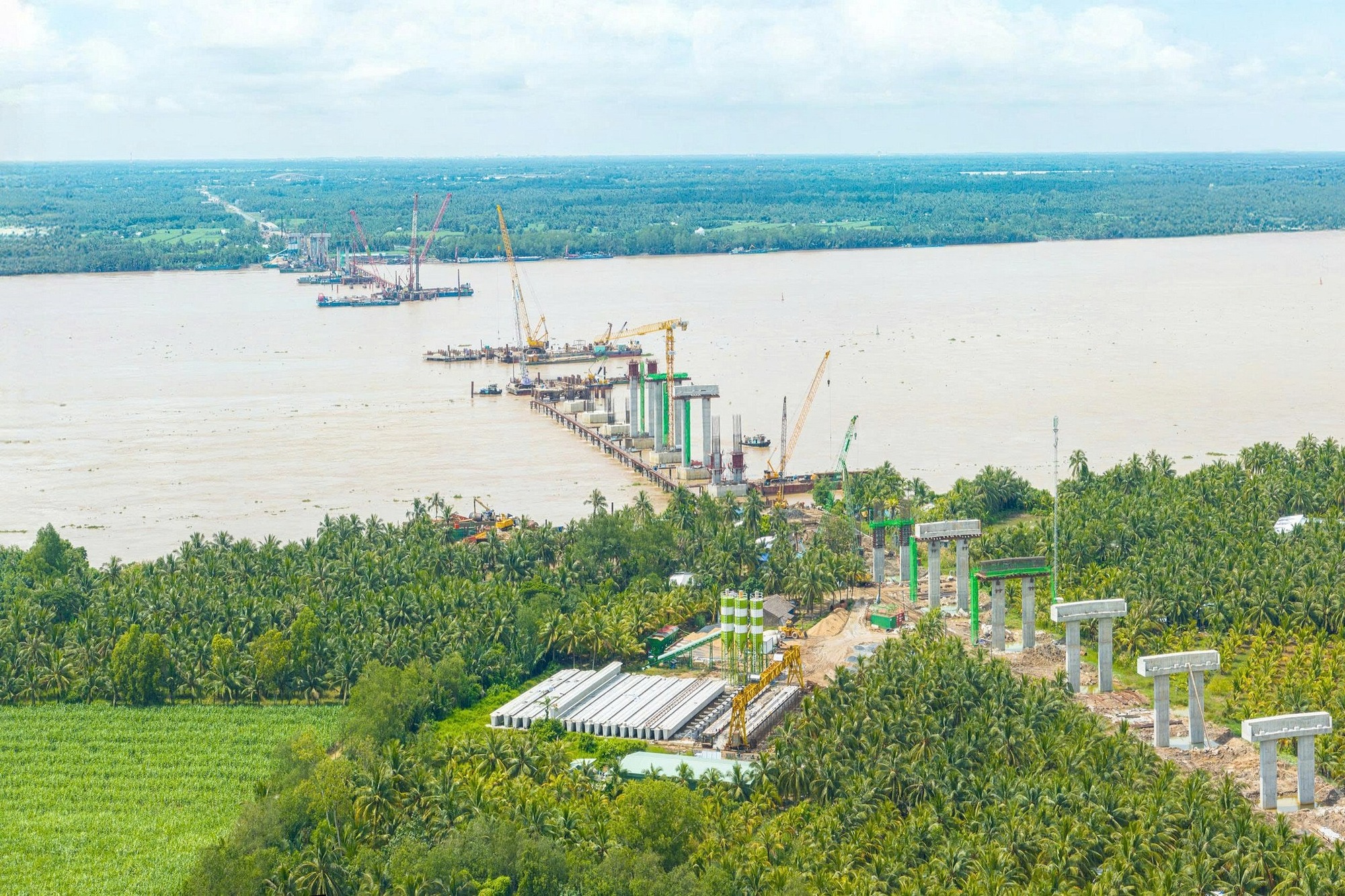
Large-scale bored piling drilling rigs, 300-ton cranes, and 5,000-ton barges have been mobilized for the construction of Dai Ngai 1 Bridge.
These days, the Dai Ngai 1 cable-stayed bridge construction site is always bustling with machinery operating under the spirit of “3 shifts, 4 crews”. Mr. Cao Ngoc Nam, Deputy General Director of DEOCA Group, stated that more than 400 officers, engineers, and workers have been mobilized on site, along with 150 pieces of machinery and equipment. This includes modern equipment such as large-scale bored piling drilling rigs, 300-ton cranes, and 5,000-ton barges. Thirty construction fronts are operating simultaneously.
Dai Ngai 1 Bridge is located near the sea entrance, where weather conditions involve rain and wind, and geological conditions are complex. Therefore, during construction, the contractor had to develop models and conduct wind tunnel tests abroad.
Furthermore, the two main towers of the bridge involve a complex construction process. Given the weak soil foundation typical of the Mekong Delta, Dai Ngai 1 Bridge is designed with the largest and deepest bored piles in Vietnam, 2.5 m in diameter and a depth up to 116 m, comparable to Vam Cong Bridge.
According to calculations, each pile required an average of 6 days for construction, with the category originally planned for completion by the end of December 2025. However, the contractor has now finished this category nearly one month ahead of the approved schedule. This marks a crucial transition step in preparing for the construction of tower bases and cable-stayed tower bodies.
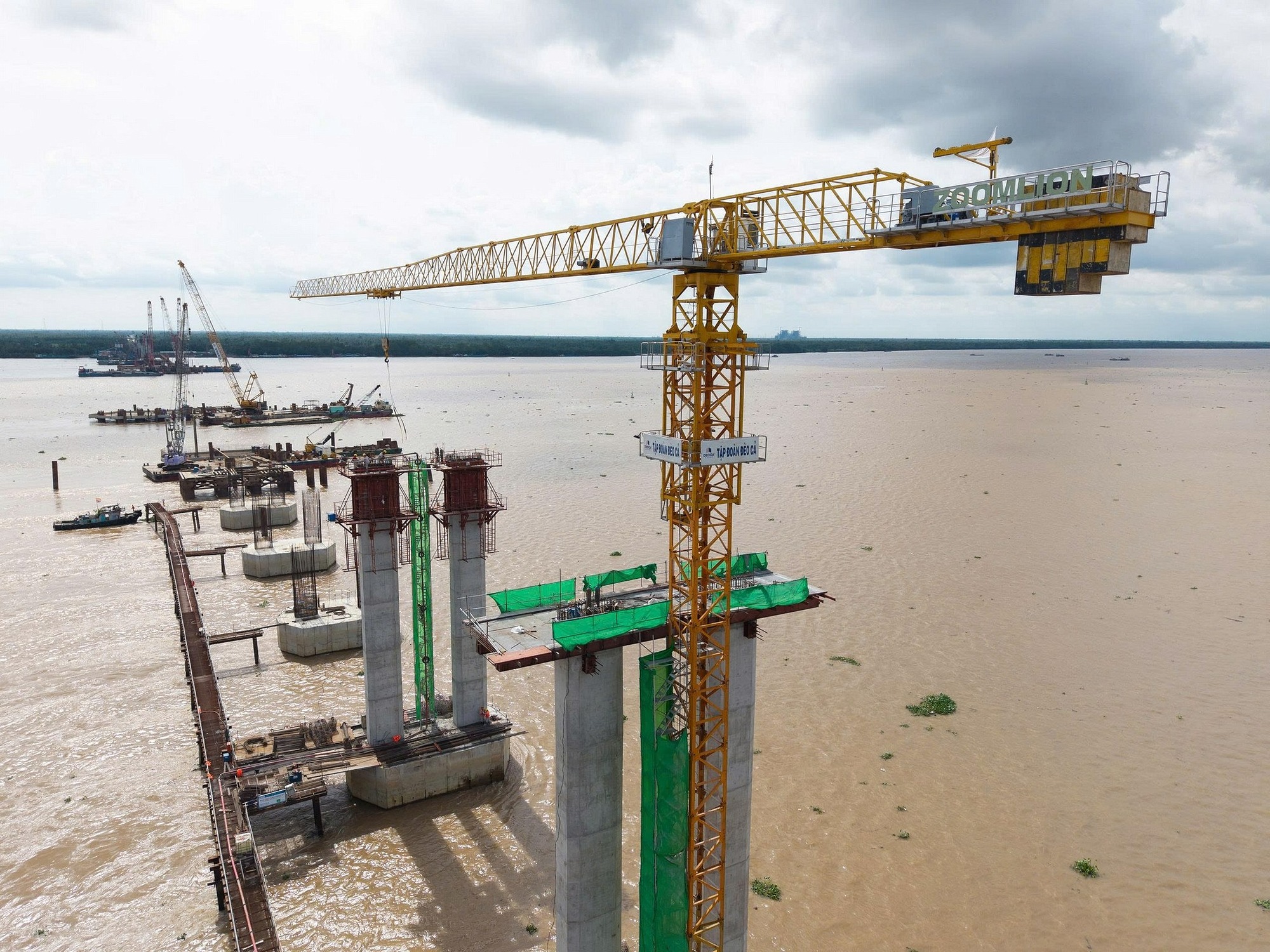
The Dai Ngai 1 cable-stayed bridge construction site is always bustling with machinery operating under the spirit of “3 shifts, 4 crews.”
The biggest difficulty at present is unfavorable weather conditions, as the Southwest region is entering the rainy and stormy season. The Hau River is wide, and prolonged rain and thunderstorms cause large waves and strong winds, leading to the interruption of construction fronts on the river.
To maintain the plan, the Project Management Board has proactively arranged backup manpower and equipment. They also have flexibly adjusted construction plans to ensure both safety and work rhythm, minimizing the impact of weather as much as possible.
According to the Project Management Board's report, all 60 bored piles with a diameter of 1.5 m for the approach bridges have been completed. In addition, 6 pier bases, 2 pier bodies, 1 cap beam, and 25/28 Super T girders have already been constructed. The entire pier body and cap beam sections are expected to be completed by the 2026 Lunar New Year, moving towards the construction of the superstructure in the new year.
Mr. Cao Ngoc Nam stated that in the upcoming period, full efforts will be concentrated on completing the pouring of concrete for the tower bases, with a volume exceeding 9,000 m³. This is a large-scale category requiring meticulous preparation in terms of equipment, manpower, and construction solutions. It must ensure both safety and compliance with technical requirements.
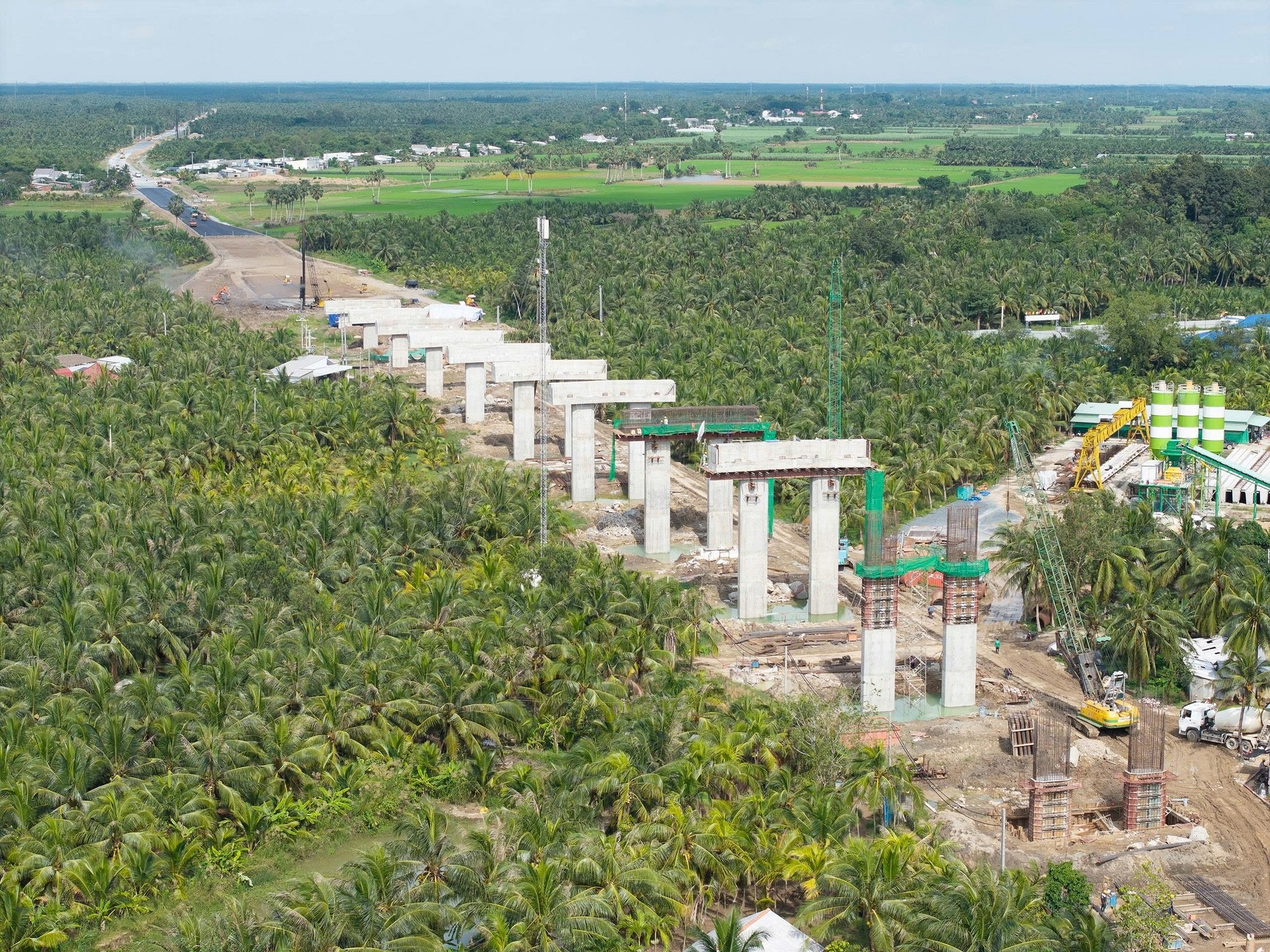
The approach road section on the Tra Vinh Province side is accelerating embankment construction, ready to connect with the bridge category.
At both ends of the bridge, soft soil treatment has been completed using wick drains and cement-deep mixing pile (CDM) methods. Currently, construction teams are placing subgrade sand and preloading, striving for completion in November 2025. This will enable immediate connection with the main bridge category as soon as conditions allow.
Upon completion, Dai Ngai Bridge, along with Rach Mieu Bridge, Ham Luong Bridge, and Co Chien Bridge, will enhance transportation capacity for the Mekong Delta region. It will create convenient traffic connections between southern coastal provinces and Ho Chi Minh City. This will shorten travel time, reduce transportation costs, expand trade, and break the single-route monopoly of National Highway 1A.
News: Lam Tra - Photos: To Hung