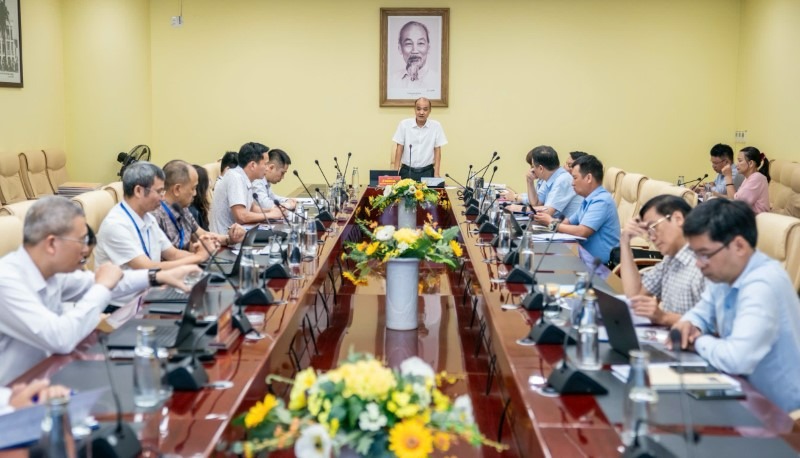


On the afternoon of September 10, at the Government Office headquarters, DEOCA Group attended a meeting where Politburo Member and Permanent Deputy Prime Minister Pham Gia Tuc worked with the Vietnam Association of Construction Contractors and several construction enterprises.
Delivering the opening speech at the working session, the Permanent Deputy Prime Minister said the Government continues to strengthen dialogue and work directly with construction associations and enterprises to listen to and resolve difficulties and obstacles in production and business activities.

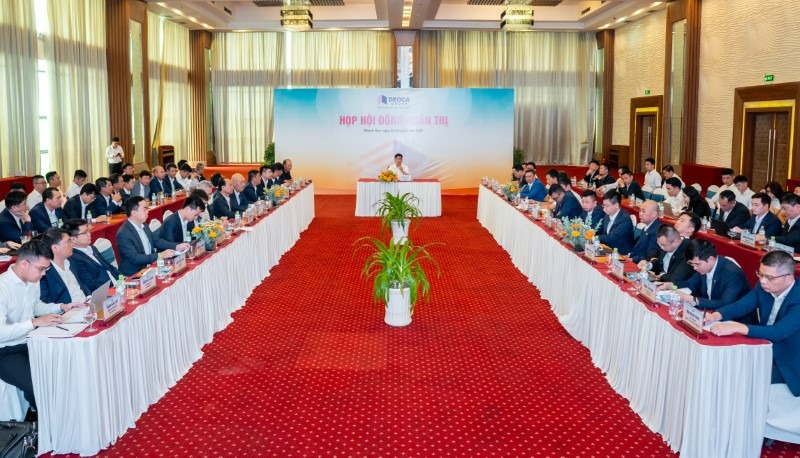
An overview of the meeting.
The Permanent Deputy Prime Minister requested the Association to focus on reporting new recommendations, obstacles, and fundamental issues, especially content that ministries and sectors have not resolved or have resolved unsatisfactorily. Regarding issues within the jurisdiction of the National Assembly or other agencies, the Government will synthesize, report, and recommend that competent authorities consider and resolve them according to regulations.
Creating opportunities for Vietnamese enterprises to mature from large projects
Chairman of the Vietnam Association of Construction Contractors Nguyen Quoc Hiep stated that, based on synthesizing opinions from enterprises, the Association recommended continuing to resolve the construction sector's obstacles, focusing on the contractor selection mechanism, organizing the implementation of large-scale projects, managing costs, materials, human resources, and managing contracts.
Specifically, the Association recommended researching the expansion of contracting methods, perfecting the mechanisms for general contractors, managing contractors, and subcontractors while organizing bidding packages suitable to enterprise capacity and clearly delineating responsibilities and risks among parties. This will create conditions for domestic contractors to improve their organizational and management capacities and gradually assume larger roles in large-scale projects.
Chairman of the Vietnam Chamber of Commerce and Industry (VCCI), Mr. Ho Sy Hung believed that the practical implementation of public investment projects still shows a gap between market requirements and management mechanisms. Besides issues regarding unit prices, norms, and construction materials, VCCI recommended continuing to perfect the contractor selection and management mechanism, which creates conditions for domestic enterprises to participate more deeply in large-scale projects and gradually undertake stages with high added value.
Sharing the same viewpoint on the requirement to improve domestic enterprise capacity, Mr. Nguyen Le Bach, General Director of the Group, represented DEOCA Group at the meeting and shared some issues from the practical implementation of transportation infrastructure projects while recommending solutions to better promote the capacity of Vietnamese construction enterprises.

Mr. Nguyen Le Bach, General Director of DEOCA Group, delivered a speech at the meeting.
First, it is necessary to create conditions for domestic construction enterprises to gradually master technology, management, and the organization of implementing large projects.
According to Mr. Bach, the Government has recently paid attention to and encouraged innovation and enterprise capacity improvement. For this policy to be put into practice, it is necessary to create opportunities for capable enterprises to gain practical experience at large domestic projects.
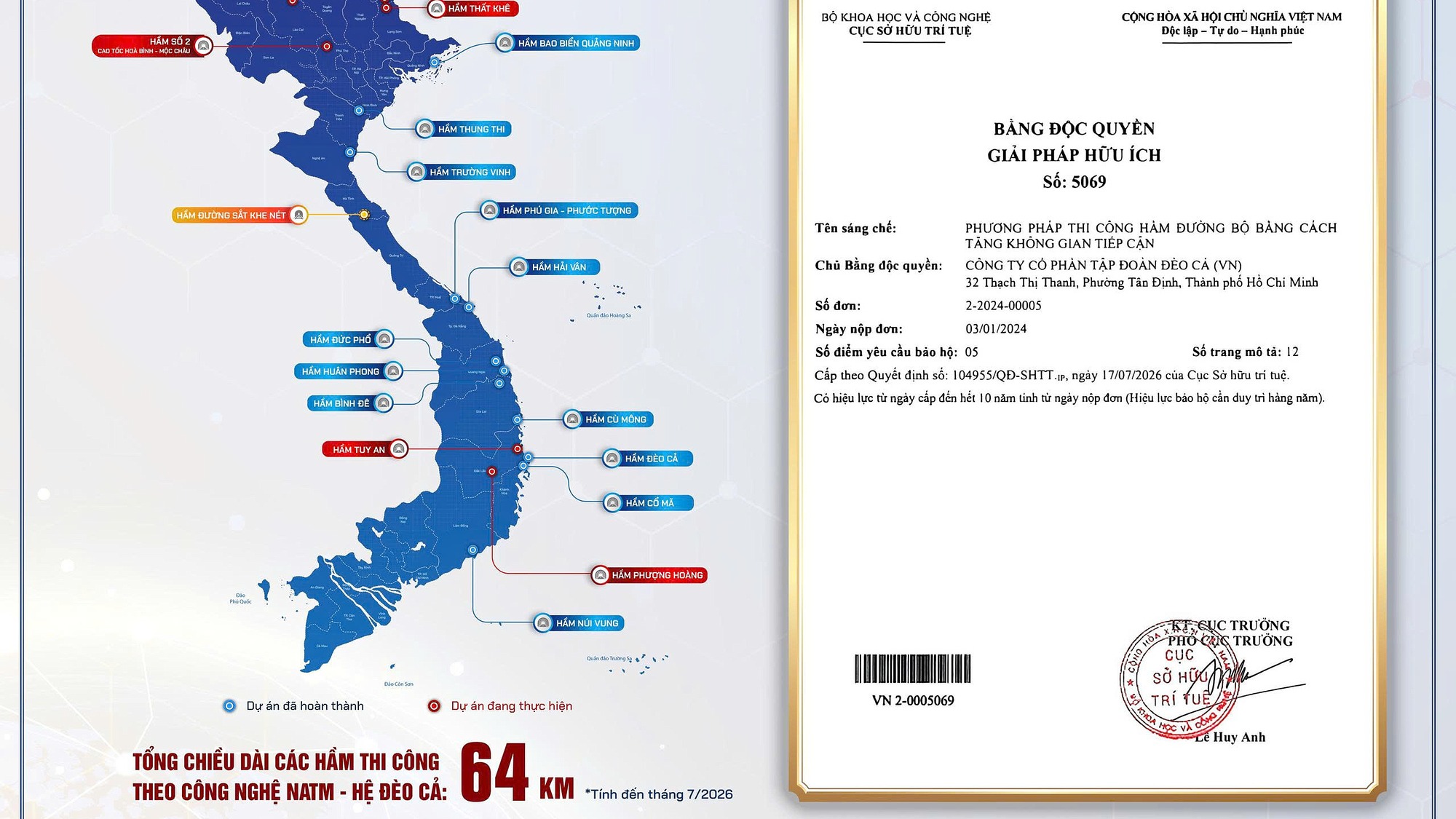
DEOCA Group has also matured from this very process. In the field of road tunnels, from having to learn foreign technology, the enterprise has gradually mastered and improved the NATM technology to suit geological conditions, construction organization, and Vietnamese people, which formed the “DEOCA NATM System” method. From that experience, DEOCA Group is continuing to prepare resources to advance toward mastering TBM technology in constructing underground tunnels, metros, and railways.
“If Vietnamese enterprises are not assigned work to gain practical experience right on the country's projects, it will be very difficult to mature; trained resources will be wasted, and we will continue to have to depend on foreign contractors, experts, and technologies”, Mr. Bach said.
Second, it is necessary to innovate the method of selecting and organizing contractors towards assigning responsibilities commensurate with capacity.
For large projects and especially route-based projects, DEOCA Group recommended limiting the division of a route section into too many separate bidding packages. Instead, it is necessary to select a capable contractor or general contractor, assign synchronized implementation, and hold them ultimately responsible for progress, quality, costs, and efficiency.
Specialized items can be organized and implemented through a subcontractor system. However, according to the representative of DEOCA Group, the important thing is not to mechanically control the subcontracting ratio but to determine who is truly managing, directing, and bearing the ultimate responsibility.
Therefore, DEOCA Group recommended clearly distinguishing the use of subcontractors to organize and mobilize resources from the act of transferring or selling bids. If this issue is not clarified, it will lead to a paradox where on the one hand, there is a goal to form large general contractors, but on the other hand, the mechanism restricts the ability of the general contractor themself to organize the contractor chain and mobilize resources.
Third, it is necessary to shift strongly from procedural management thinking to results management and reasonable risk allocation.
During the contract implementation process, according to Mr. Bach, it is necessary to clearly distinguish what is an objective risk, what is the subjective fault of the parties, and what is an act of law violation. We should not infer responsibility just because a project incurs costs or requires contract adjustments without fully considering the causes, faults, damages, and causal relationships.
For projects spanning many years, there needs to be a mechanism for periodic review and risk allocation instead of waiting until an incident occurs to handle it. Especially for EPC contracts, risks need to be clearly allocated according to each stage of designing, procuring, and constructing.
From the practice of DEOCA Group, Mr. Nguyen Le Bach emphasized that the goal of the above recommendations is not to create favorable mechanisms for a single enterprise but to aim at forming a generation of Vietnamese construction enterprises with sufficient international competitiveness. The State creates mechanisms and sets standards while enterprises must self-innovate, invest in people and technology, and be responsible for their products.
Once they have matured from domestic projects, Vietnamese enterprises need to aim to bring their capacity, technology, and engineering teams to the international market to undertake jobs with high technical content such as tunnels, bridges, metros, and railways which thereby create jobs, foreign currency revenue, and gradually build the brand of the Vietnamese construction industry in the international market.
“We recommend a mechanism for capable enterprises to be assigned work, to compete, to be responsible, and to mature. Only with work to gain practical experience can there be capacity. Only with capacity can technology be mastered. Only by mastering technology can we step out into the world”, the General Director of DEOCA Group emphasized.
Researching general contractor and management contractor mechanisms in the draft law
Responding to the recommendations of the Association and enterprises, Mr. Tran Hao Hung who is the Director of the Public Procurement Agency (Ministry of Finance) stated that this agency is researching the mechanisms of general contractors, contractor consortiums, and management contractors for consideration and completion in the draft Bidding Law or regulations in Decrees.
According to the representative of the Public Procurement Agency, applying these models is necessary, but it also requires the Association and enterprises to continue clarifying the connotations, operating mechanisms, rights, obligations, and responsibilities of general contractors, contractor consortiums, and management contractors while distinguishing them from forms already regulated by current laws such as contractor joint ventures and EPC contracts. This will be the basis for management agencies to research and perfect an appropriate legal corridor.

Mr. Tran Hao Hung, Director of the Public Procurement Agency (Ministry of Finance), delivered a speech at the meeting.
Regarding the issue of subcontractors and bid transfers, the Director stated that the draft Bidding Law is being perfected to clarify the connotation of bid transfer acts. Notably, the draft has removed the regulation on the percentage of work value assigned to subcontractors as a basis for determining bid transfer acts.
The Public Procurement Agency stated it will continue to exchange directly with the Association and enterprises to clarify remaining obstacles before perfecting the draft and reporting to competent authorities.
Representatives of ministries and sectors also agreed that it is necessary to continue perfecting regulations on subcontractors, bid transfers, joint ventures, general contractors, and management contractors towards clearly delineating responsibilities and powers that are suitable to the practical implementation of large projects. The opinions simultaneously supported researching mechanisms that create conditions for Vietnamese contractors to improve capacity and gradually undertake the roles of general contractors and EPC general contractors in large-scale projects.
Handling recommendations focus on clear tasks, clear responsibilities, and clear results
Concluding the working session, Permanent Deputy Prime Minister Pham Gia Tuc affirmed that the Government will continue to accompany, resolve difficulties, and create a favorable environment for enterprises to develop. The recommendations of the Association and enterprises must be received and handled promptly and substantively with a spirit of clear tasks, clear responsibilities, and clear results where issues related to mechanisms, policies, or those exceeding jurisdiction need proactive research, proposal of plans, and reporting to competent authorities for consideration.

Permanent Deputy Prime Minister Pham Gia Tuc delivered the concluding speech of the meeting.
Deputy Prime Minister emphasized that along with perfecting institutions, it is necessary to improve the efficiency of implementation organization which ensures that legal regulations both meet state management requirements and align with reality while facilitating production and business activities. Handling enterprise recommendations must aim to resolve issues substantively and definitively which avoids merely citing legal regulations generally.
Regarding the improvement of domestic construction enterprise capacity, the Deputy Prime Minister requested enterprises to continue innovating management models, improving project management capacity, and accelerating the application of science, technology, mechanization, automation, and BIM to increase productivity and gradually master technology.
Simultaneously, enterprises need to strengthen linkages and cooperation to be capable enough to participate in implementing national key structures and large projects while promoting specialization, task division, and cooperation to improve the operational efficiency and competitiveness of Vietnamese construction enterprises.
Deputy Prime Minister also emphasized the requirement to develop human resources that meet the development of science and technology. The State, universities, and enterprises need to strengthen coordination and link training with practical needs, where enterprises proactively identify human resource needs and focus on building a team of engineers and technical workers capable of mastering modern machinery and technology.
Previously, at a meeting organized by the Vietnam Association of Construction Contractors on September 9, DEOCA Group detailed proposals to perfect the mechanism for selecting and organizing contractors and managing contracts, which creates conditions for domestic construction enterprises to promote their capacity and undertake the role of general contractors in large-scale infrastructure projects. I. PERFECTING THE MECHANISM FOR SELECTING AND ORGANIZING CONSTRUCTION CONTRACTORS 1. Reasonably dividing bidding package scales for large projects and route-based projects For large-scale infrastructure projects and especially route-based transportation projects, dividing them into too many small bidding packages can increase management focal points, generate interfaces and overlaps among contractors, and make it difficult to determine responsibilities when schedule delays, quality defects, or operational and warranty issues occur. It is recommended to research dividing bidding packages by route sections which suit the project scale and the contractor's implementation capacity where reference can be made to a scale of approximately USD 113.6 million to USD 189.4 million per package while limiting the separation of items belonging to the same route section such as lighting, ITS, and traffic safety. Accordingly, priority should be given to selecting a capable contractor or general contractor responsible for synchronously implementing the entire route section, where specialized items can be organized and implemented through appropriate subcontractors. The overarching principle is that the right to organize implementation must be tied to the ultimate responsibility for the progress, quality, cost, safety, operation, and warranty of the structure. The division of bidding packages needs to be flexible according to the nature of each project, which avoids mechanical application. 2. Perfecting the mechanism to control unusually low bid prices and anti-dumping Decree No. 214/2025/ND-CP already has a handling mechanism for cases where contractors offer prices lower than 80% of the bidding package price, which requires explaining the feasibility of the bid price and allows increasing the contract performance security level. However, the current regulation primarily stops at the explanation requirement and has not fully quantified what constitutes an unusually low bid price that does not ensure implementation ability. It is recommended to build criteria and quantitative thresholds to identify unusually low bid prices that require contractors to prove the basis for price formation, productivity, technology, supply sources, and implementation ability. If feasibility cannot be proven, there must be appropriate handling measures. Simultaneously, it is necessary to publicize on the National Bidding Network System the implementation status of contracts with unusually low winning bid prices, which includes progress, contract adjustments, variations, and violations, if any. The goal is to ensure competition based on capacity, technology, and governance efficiency rather than primarily competing by lowering prices to win bids and then incurring difficulties during implementation. 3. Clearly distinguishing subcontractors from bid transferring and bid selling Evaluating bid transfers should not primarily rely on the percentage or value of work assigned to subcontractors but needs to consider the nature of responsibility transfer. The main contractor or general contractor must have the right to proactively organize resources and select appropriate specialized subcontractors, but they must continue to directly organize and manage contract implementation; control progress, quality, and safety; coordinate subcontractors; and bear full and ultimate responsibility to the investor. Bid transferring is when the winning contractor transfers to other organizations or individuals all or a major part of the work and management and operational responsibilities that must be performed by the winning contractor themself according to the bidding documents, bid dossiers, and contracts, which substantially changes the subject performing and bearing responsibility for the bidding package. Accordingly, it is necessary to focus on controlling acts of transferring the entire bidding package or the entire contract scope of work to another subject; transferring work that the bidding documents, bid dossiers, or contracts require the winning contractor themself to directly perform; transferring that substantially changes the established scope, responsibility, or performing subject; or transferring both management and operational rights and responsibilities for the bidding package. Through this, clear distinctions can be made between organizing a legal subcontractor system and the acts of selling bids or transferring bids. II. PERFECTING THE GENERAL CONTRACTOR MECHANISM TO CREATE CONDITIONS FOR FORMING LARGE-SCALE CONSTRUCTION ENTERPRISES For large infrastructure projects, having a capable focal point to organize design, construction, technology, supply chains, and subcontractor systems will help reduce interfaces, increase responsibility, and improve governance efficiency. Therefore, it is recommended to continue researching and perfecting the legal corridor for general contractors and general contractor models suitable for each type of project, which ensures compatibility between the right to organize implementation and ultimate responsibility. An enterprise undertaking the role of a general contractor must prove their capacity regarding finance, human resources, experience, technology, governance, organizing contractor chains, controlling quality, progress, safety, and ultimate responsibility. The management mechanism needs to gradually shift from intervening too deeply in the enterprise's resource organization methods to controlling input capacity, output results, and ultimate responsibility. The goal helps state agencies focus on their correct functions of building standards and controlling quality, progress, costs, transparency, and investment efficiency. III. PERFECTING THE CONTRACT MANAGEMENT AND RISK ALLOCATION MECHANISM 1. Clarifying bases for contract modification and responsibilities of the parties When contracts require adjustments to value, costs, or progress, it is recommended to clearly delineate objective risks, a party's subjective fault, civil liability, and damage compensation versus acts exhibiting signs of law violations. Responsibility should not be inferred solely based on increased contract value or extended implementation time. Determining responsibility needs to fully rely on causes, obligations, faults, damages, causal relationships, and the scope of risks allocated in the contract. Simultaneously, there needs to be guidance on methods to objectively determine actual damages with evidentiary bases directly tied to the violation acts, which limits the risk of civil contract disputes being incorrectly assessed in nature. 2. Clarifying force majeure and fundamental changes in circumstances It is recommended to continue detailing criteria regarding foreseeability, controllability, prevention obligations, the scope of risks allocated at the time of contract signing, and methods to determine the level of severe impact on costs and progress. Research can be conducted to build a list of typical risk groups and events in construction activities for parties to reference during contract negotiations. Especially, it is necessary to clarify responsibilities regarding cases where the contracting party, particularly in state-funded projects, delays or cannot make payments due to objective reasons; determining whether this falls under force majeure or the contracting party's financial risk to limit disputes. 3. Risk management for large-scale and prolonged projects For projects and bidding packages with implementation periods exceeding 24 to 36 months, it is recommended to have a periodic contract review mechanism to proactively identify and update risks while adjusting insurance scopes corresponding to the time, volume, and nature of the project. For EPC contracts, it is necessary to clearly allocate risks according to each E - P - C stage, which includes designing, procuring, and constructing, instead of general regulations as currently practiced. |
News: Gia Nhu - Photo: Tuan Linh